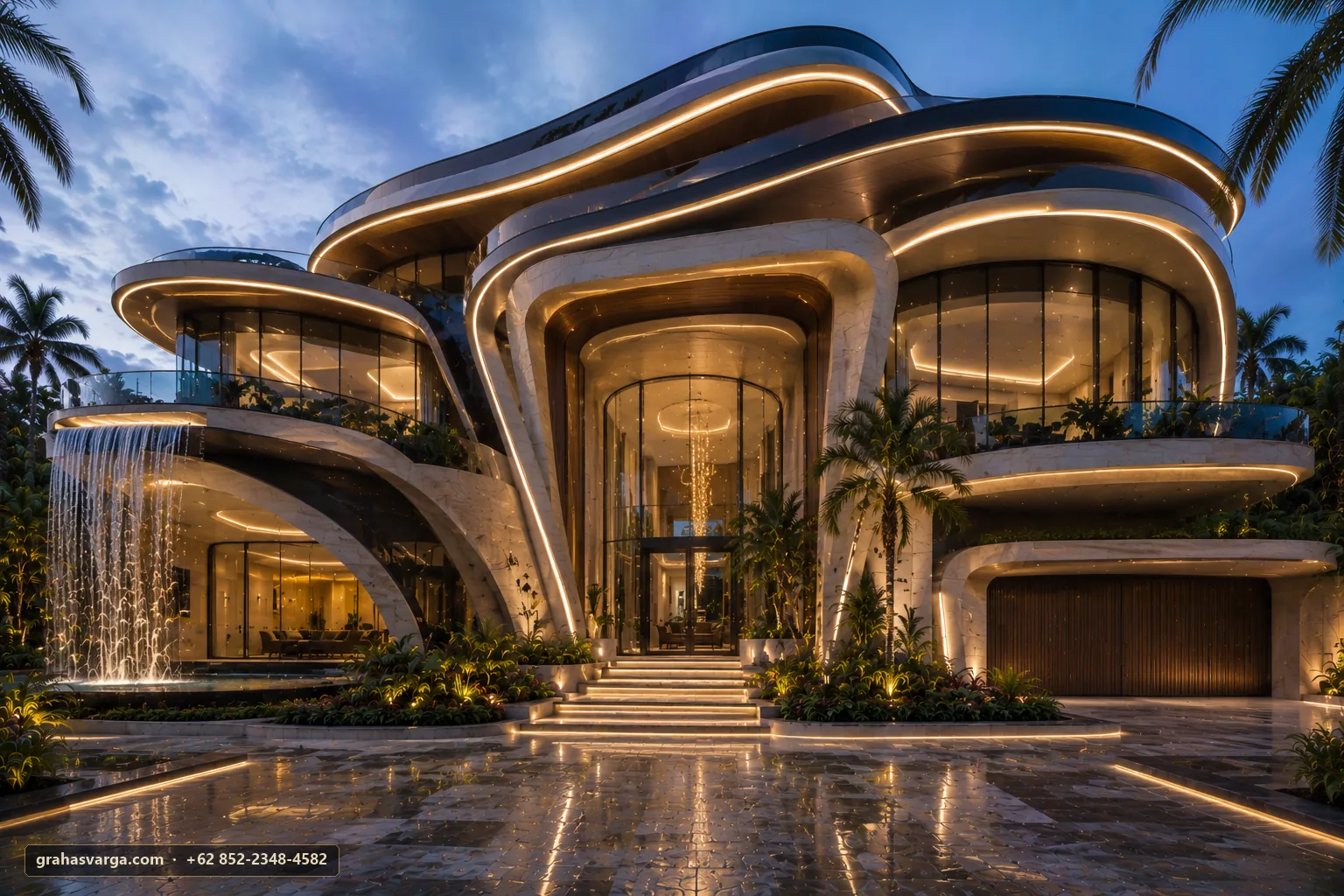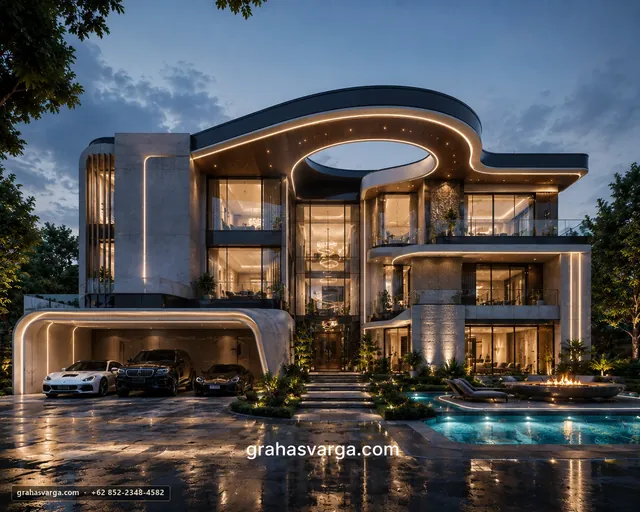
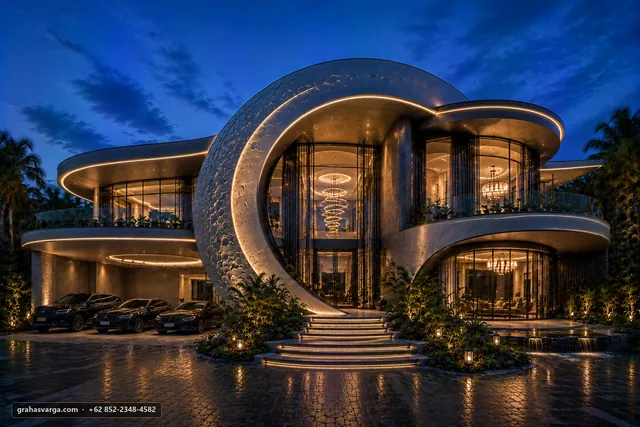
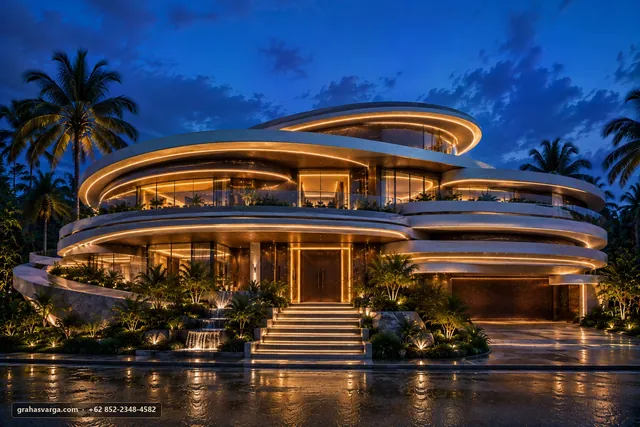
What Is Architecture, Really? is part of the Graha Svarga Architecture Library—where space, people, technology, construction, and the future are examined as one field of thought.
Architecture Is More Than the Form of a Building
Form is the most immediately visible part of architecture. For that reason, form is also often mistaken for architecture itself.
Yet a building may look highly attractive and still be uncomfortable to inhabit. A space may appear remarkable in an image yet have poor circulation. A façade may look futuristic yet expose the interior to excessive solar heat. A house may use extremely expensive materials yet fail to provide the privacy its occupants need.
Conversely, a visually simple building may possess exceptional architectural quality because its light, proportions, circulation, function, structure, materials, and relationship with its surroundings have all been carefully considered.
To judge architecture solely by appearance is therefore like judging a book solely by its cover.
Form matters, but it is only one part of the whole system.
Architecture Shapes Space for Life
Imagine a house without furniture or decoration.
Something can still be felt.
Some spaces feel expansive, others intimate. A corridor directs our steps. An opening draws the eye towards a garden. A wall offers protection. A courtyard brings different parts of the house together. Morning light enters from a particular direction, while shadows move with the course of the sun.
All of these shape experience.
Architecture operates through the relationship between people and space.
This is why two rooms of identical area do not necessarily offer the same experience. Differences in ceiling height, opening size, direction of light, materials, proportion, relationships with other spaces, views, temperature, and sound can make them feel entirely different.
Dimensions can be calculated in numbers.
But spatial quality emerges from the relationship of many things at once.
People Are the Reason Space Exists
A house is not built for a floor plan.
A house is built for life.
Within it, someone wakes in the morning, children grow, families eat together, guests arrive, work is done, someone seeks quiet, belongings are stored, celebrations take place, and time slowly leaves its traces.
Design, therefore, should not ask only:
“What spaces are required?”
The deeper question is:
“What kind of life will unfold within those spaces?”
Two families with the same number of members may need very different houses.
One family may frequently welcome many guests. Another may place a high value on privacy. One person may work from home, while another needs space for a collection. Some families live in close relationship with the garden, while others require greater security and stronger separation between spaces.
The list of rooms may look similar.
The architecture may not.
This is where design begins to move beyond arranging rooms towards understanding people.
Architecture Also Speaks with Place
A building never truly stands alone.
It occupies a piece of land with a particular orientation to the sun, winds, rain, temperature, contours, vegetation, roads, neighbours, views, noise, culture, and environmental character.
A design that succeeds in one place may therefore be inappropriate when transferred elsewhere.
A house designed for a cold climate faces different questions from one in a humid tropical region. A building on a narrow urban site faces different questions from a villa on a hillside with expansive views.
Good architecture does not merely place an object upon the land.
It reads the place before changing it.
Where does the sun come from? Where does rainwater flow? Which part has the finest view? Where does the noise originate? How do people enter the site? What should be opened? What, instead, needs protection?
Questions such as these gradually transform the conditions of a site into architectural decisions.
Between Strength, Usefulness, and Beauty
Discussion about architectural quality has been taking place for a very long time.
One classical idea still discussed today comes from Vitruvius, the ancient Roman writer on architecture. His thought is often summarised through three principles: firmitas, utilitas, and venustas—which may be understood simply as solidity or strength, usefulness, and beauty.
Together, they help explain why architecture cannot pursue only one dimension.
A beautiful building that is unsafe is a failure.
A strong building that cannot properly serve its users is also problematic.
A functional building that entirely neglects spatial quality and human experience forfeits part of its architectural potential.
In contemporary buildings, the questions are more complex still. Architecture must engage with structure, mechanical and electrical systems, energy, water, safety, technology, accessibility, the environment, materials, construction cost, maintenance, and many other disciplines.
Architecture stands amid these different concerns and seeks to compose them into a coherent whole.
Architecture Is Art, but It Is Also Knowledge
Architecture often occupies a fascinating territory because it is neither wholly art nor wholly an engineering matter.
Imagination is needed to discover new possibilities.
But gravity cannot be negotiated by imagination.
Proportion and composition may involve visual sensitivity, but a building must still stand. Light may be used to create atmosphere, but the heat it carries must also be understood. Free form may offer an intriguing idea, but it carries consequences for structure, materials, workmanship, cost, and maintenance.
A designer therefore moves continually between two worlds.
The world of possibility and the world of reality.
Too far towards one side may produce a building that is correct yet devoid of life.
Too far towards the other may produce an astonishing idea that is difficult to realise.
Architecture grows when imagination and knowledge are able to work together.
Architecture Unfolds Through Time
There is another dimension often forgotten when looking at architectural images: time.
An image shows a building in a single state.
Life does not.
The sun moves. Rain comes. Materials age. Trees grow. Technology changes. Children become adults. Older people need greater ease of movement. Spatial needs change. Some functions disappear and new ones emerge.
A building that feels perfect today will encounter a life that never stops moving.
The architectural question, therefore, should not be only:
“How will this building be used when it is completed?”
But also:
“How will this building live ten, twenty, or fifty years from now?”
Thinking in this way changes how we understand flexibility, materials, maintenance, technology, structure, and even the way a house may be passed on to the next generation.
Architecture and Technology
Throughout history, technological development has continually transformed what architecture can make possible.
Stone enabled people to build things that could endure for a very long time. The development of arches and domes made wider spaces possible. Iron, steel, and concrete transformed building spans and heights. Glass changed the relationship between interiors and the outside world. Mechanical systems altered the way people could control the environment within buildings.
Today, digital technology is once again transforming this process.
Three-dimensional modelling, Building Information Modelling, environmental simulation, digital fabrication, building automation, sensors, artificial intelligence, and many emerging technologies are expanding our ability to design, test, construct, and manage buildings.
Yet technology remains a tool.
A house containing hundreds of automated devices is not necessarily a better home.
Technology gains value when it helps people live with greater comfort, safety, efficiency, health, or freedom.
Buildings may become increasingly intelligent. The reason for that intelligence remains human.
Architecture Is Not the Work of a Single Discipline
The more complex a building becomes, the clearer it is that architecture does not stand alone.
Architects and designers need to coordinate with structural engineers, mechanical, electrical and plumbing specialists, lighting consultants, landscape and interior designers, security and acoustic consultants, contractors, material suppliers, site workers, and many other specialists.
Architecture, therefore, is not about one person knowing everything.
One sign of maturity in design is precisely the ability to understand relationships between disciplines, recognise the limits of one's competence, and know when a question requires someone else's expertise.
A good building is the result of many decisions successfully meeting in the same place.
So, What Is Architecture, Really?
No single sentence can contain its entire meaning.
Architecture is building, but it is broader than building.
It is connected with art, yet cannot escape physical reality.
It uses technology, but technology is not its purpose.
It shapes space, but that space exists for life.
It is born in a particular place, faces a particular age, and must then endure through time.
Perhaps, then, we can understand it more simply:
architecture is the human endeavour to shape space so that life may unfold more fully.
Within that endeavour, need meets beauty, imagination meets calculation, the individual meets society, building meets nature, and past meets future.
A line on an architectural drawing may ultimately become a wall that stands for decades.
An opening may determine how morning light enters a house each day.
A decision about a staircase may influence how someone moves throughout a lifetime.
A tree that is preserved may become a place where a child plays and, decades later, where another generation sits beneath its shade.
This is why architecture is far greater than the matter of making buildings look beautiful.
Architecture is about shaping places for life—and recognising that every space we shape ultimately helps to shape the people who live within it.
Knowledge is gathered to sharpen decisions and draw architectural possibility into reality.